
The $700K Problem Most Founders Ignore
When Lee Weiland reached out to me in 2021, Pacific Rim Athletics was stuck at $600K per year despite having an elite coaching product and a small but engaged YouTube audience of 3,000 subscribers.
His biggest frustration? “We’re invisible online. We need predictable growth, not just hoping for referrals.”
Sound familiar?
Here’s what wasn’t working:
- Only 4-5 inbound leads per month (completely unpredictable)
- 20 sales per month (mostly from referrals)
- No consistent content strategy
- No paid acquisition channel
- Generic messaging that didn’t differentiate them from other fitness programs
- No email nurture system (leads went cold fast)

Two years later, Pacific Rim Athletics had transformed:
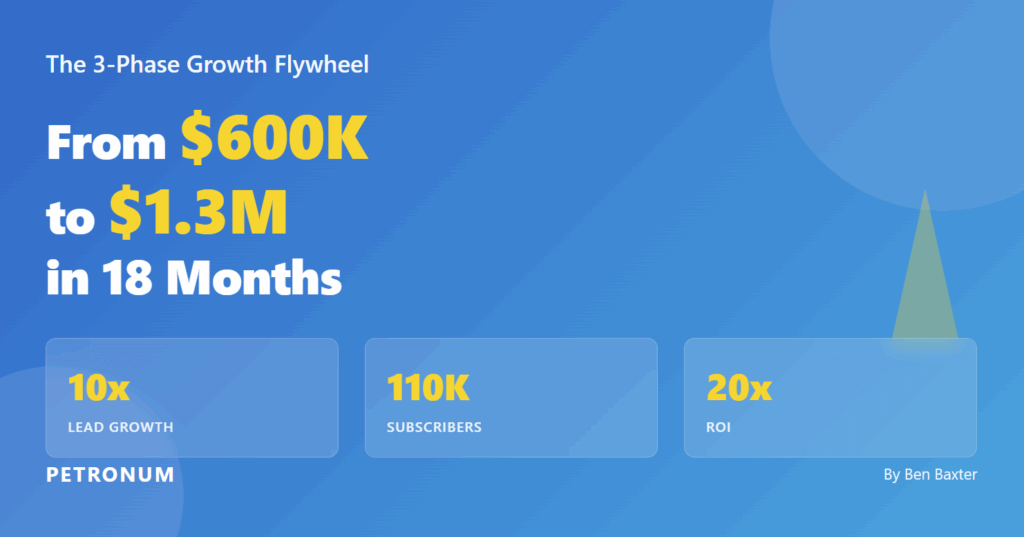
- $1.3M in annual revenue (117% growth)
- 50 inbound leads per month (10x increase)
- 35 sales per month (75% increase)
- 110,000 YouTube subscribers (3,600% growth)
- $11 cost per lead sustained for 2 years
- 80% increase in customer lifetime value ($2,500 to $4,500)
The total ROI? Between 8.3x and 20x depending on how you calculate lifetime value.
But here’s what matters more than the numbers: the system still runs without me. That’s the difference between a campaign and a growth engine.
Why Most Growth Strategies Fail
After managing over $10M in ad spend and working with 50+ brands from solo coaches to 8-figure companies like Ka’Chava, I’ve seen the same pattern repeat itself:
Founders invest in tactics, not systems.
They hire someone to:
- “Do their LinkedIn”
- “Run some Facebook ads”
- “Create content”
- “Fix their funnel”
Each of these is a single tactic. And tactics without a system create three predictable problems:
- No compounding effect – When you stop, growth stops
- No attribution clarity – You can’t tell what’s actually working
- No sustainability – You become the bottleneck
This is why agencies churn clients every 30-90 days. They deliver tactical wins but never build the underlying engine.
The 3-Phase Growth Flywheel Framework
After working with clients ranging from $500K to $30M in revenue, I developed what I call the 3-Phase Growth Flywheel. This is the exact system I used to transform Pacific Rim Athletics and dozens of other founder-led businesses.
Phase 1: Map Your Growth Journey
Before you spend a dollar on ads or create another piece of content, you need absolute clarity on three things:
1. Positioning & Messaging
Most businesses fail here. They describe what they do instead of who they help and what transformation they provide.
For Pacific Rim Athletics, we repositioned them from “just another fitness program” to “elite bodyweight coaching for advanced athletes” (not beginners). This immediately differentiated them in a crowded market.
Your positioning should answer:
Your offer needs to be clear, high-value, and aligned with your ideal customer’s buying journey.
This means:
- Clear pricing (no “contact us for pricing”)
- Defined outcomes (not features)
- Strategic positioning (high-ticket or high-volume)
3. Funnel Design
Most funnels leak because they skip critical steps. The ABC Framework fixes this:
- Attention: How do they discover you? (LinkedIn, YouTube, referrals)
- Belief: Why should they trust you? (case studies, content, authority)
- Choice: What action do they take? (lead magnet, call booking, purchase)
For Pacific Rim Athletics, we built:
- Lead magnet targeting advanced athletes
- Automated email nurture sequence
- High-converting sales pages using direct response copywriting
Phase 2: Amplify Your Impact
Once your foundation is solid, it’s time to scale attention and qualified leads. This is where most people jump in too early (and waste money).
Multi-Channel > Single Tactic
For Pacific Rim Athletics, we didn’t just “do YouTube” or “run ads.” We built an integrated system:
YouTube Organic (Authority Engine)
- Scripted viral content showcasing their expertise
- One video alone got 100K+ views
- Grew from 3K to 110K subscribers in 18 months
- Created trust and authority at scale
YouTube Ads (Lead Generation Engine)
- Targeted ads driving high-intent leads to a lead magnet
- Maintained $11 CPL and 2.0X ROAS consistently for 2 years
- Predictable daily lead flow
Email Nurture (Conversion Engine)
- Automated sequences converting leads to sales calls
- Increased lifetime value by keeping prospects engaged long-term
- Built relationship before the ask
The key insight: These channels worked together. The organic content created authority. The ads drove leads. The email converted them.
When you build a multi-channel engine:
- You’re not vulnerable to algorithm changes
- You compound authority over time
- You have attribution clarity
- You can identify and double down on winners
Phase 3: Scale Your Profits
Most founders think scaling means “more leads.” That’s only half the equation.
Scaling profits means:
- Increasing customer lifetime value
- Removing hidden bottlenecks
- Building systems that run without you
For Pacific Rim Athletics, we focused on:
1. Team Coordination (Not Solo Execution)
I didn’t replace their 12-person team. I coordinated with their sales team, designer, operations, and coaches to ensure the system worked seamlessly.
This created:
- Buy-in across the organization
- Sustainable execution (not dependent on me)
- Faster iteration cycles
2. Lifetime Value Optimization
We increased LTV from $2,500 to $4,500 (80% increase) through:
- Better email nurture sequences
- Upsell and cross-sell pathways
- Improved customer onboarding
3. Systems Documentation
Every win became an SOP or automation:
- Content creation process
- Lead qualification criteria
- Sales scripts
- Campaign templates
This is why the system still runs without me today.
The Real Secret: Strategic Brutality
Here’s what I don’t talk about enough: most of what we tried didn’t work.
We killed:
- 3 different lead magnets before finding the winner
- Multiple ad angles that didn’t convert
- Content formats that got no engagement
- Funnel steps that leaked leads
The competitive advantage wasn’t avoiding failure. It was failing faster and doubling down on winners.
This is what I call Speed to Signal:
- Launch fast
- Test fast
- Kill losers fast
- Double down on winners
Most founders waste 6 months perfecting something that will fail anyway. We’d rather test 10 things in 90 days and find 2 winners.
Why We Worked Together for 2 Years (Not 30 Days)
Most marketing relationships fail because they’re transactional:
- Hire an agency
- Run some campaigns
- Get disappointed
- Fire them
- Repeat
Pacific Rim Athletics worked because:
1. Real Business with a Team
They had 12 people (sales, ops, coaches, designer). This meant we could execute, not just strategize.
2. Long-Term Thinking
Lee valued durable growth over quick wins. We optimized for systems, not just campaigns.
3. Trusted Leadership
Lee followed direction without micromanaging. He trusted the process even when early tests failed.
4. Consistent Innovation
We didn’t “set and forget.” We tested new channels, angles, and funnels consistently.
This is the pattern I’ve seen with every long-term client: they treat marketing as an operating system, not a campaign.
How to Build Your Own Growth Flywheel
If you’re a founder-led business doing $500K-$30M and you’re tired of:
- Wasting money on ads that don’t convert
- Unqualified leads clogging your calendar
- Unpredictable, manual marketing that burns time and energy
Here’s where to start:
Week 1: Audit Your Current System
Ask yourself:
- How many qualified leads do I get per month?
- What’s my cost per lead?
- What’s my conversion rate from lead to customer?
- What’s my customer lifetime value?
- If I stopped posting/running ads today, what would happen?
If you don’t have clear answers, you don’t have a system.
Week 2-4: Map Your Growth Journey (Phase 1)
- Nail your positioning (who you help + transformation)
- Design your offer architecture (clear pricing + outcomes)
- Build your funnel blueprint (attention → belief → choice)
Don’t skip this. Every dollar you waste on ads without clarity here is multiplied waste.
Month 2-3: Build Your Multi-Channel Engine (Phase 2)
Pick 2-3 channels and build them simultaneously:
- LinkedIn + email (if you’re B2B)
- YouTube + email (if you’re B2C)
- Ads + organic (if you have budget)
Test, measure, kill losers, double down on winners.
Month 4+: Optimize for Profit (Phase 3)
- Increase lifetime value
- Remove bottlenecks
- Document everything
- Train your team
- Build systems that run without you
The Bottom Line
Most businesses don’t have a traffic problem. They have a system problem.
When Lee hired me in 2021, Pacific Rim Athletics wasn’t failing because they needed more ads or more content. They were failing because they didn’t have a repeatable, scalable growth engine.
We built one. And it’s still running today.
If you’re ready to stop treating marketing like a series of random tactics and start building a system that compounds over time, let’s talk.
The difference between $600K and $1.3M isn’t working harder. It’s building smarter systems.
About Ben Baxter
I build multi-channel growth engines for $500K-$30M founder-led businesses. Former Marketing Manager at Deodato Agency where I managed $10M+ in ad spend for brands like Ka’Chava, Wagr (acquired by Yahoo), and Proclaim.
I don’t do 30-day sprints. I build systems that compound.
Want to see if your business is a fit? Connect with me on LinkedIn or visit petronum.com.